It's been a good week for doggerel here at Casa Tuel. It started out innocently enough. It began as I was digging out buttercups:
The buttercup, a pretty flower
Bright and cheerful in the yard
Once it's rooted in your garden
Getting rid of it is hard.
Hardly Shakespeare, but it amused me and led to other rhymes:
Morning glory climbs the fences
Choking out the plants you want
You can pull and pull and pull
But get rid of it you cahn't.
After that I was on a roll:
Blackberries grow arching canes
That will rip you with their thorns
You might think that you have killed them
But next spring, ta-da, reborn.
Dandelions dot the yard
Golden flowers, gossamer spheres
Blowing in the summer breeze
Multiplying every year
Quack grass frolics through the orchard
Sending rootlets underground
I believe there is one plant that's
Sprouting up the world around
Ivy, once put in on purpose
Chokes the land with vines and leaves
Housing raccoons, eating houses
Sucking life out of the trees
Scotch broom ate the horse's pasture
Now it's started on the lawn
Push it back with a bulldozer
And delude yourself it's gone
Finally, I was practicing the Irving Berlin song “Easter Bonnet” to sing for a gathering of elders, and found myself writing doggerel to that old tune:
Spring is being tardy at starting up the party
I look out my window and it's raining again
I'm so tired of waiting. The weeds are germinating
But I look out my window and it's raining again
In the front yard, my front yard
All the soil is soft mud
that's up to the knees
of my old dungarees
Oh, I could use some sunshine
To dry out would be so fine
But I look out my window and it's raining again
You can see how insidious the urge to write doggerel can become. I pass the bug along to you. Go ye forth and write bad rhymes! It's something to do while you wait for the rain to let up. Cheers.
Monday, April 18, 2011


Wednesday, April 6, 2011
In Memory of Megan
Megan Belia died this week. We hoped she'd have a little longer, but nope.
So now we tell the stories.
A few years ago as we first got to know each other, Megan and I realized that we both knew Malvina Reynolds in the 1970s. Megan did the artwork for one of Malvina's album covers.
Megan and her family lived in Montana then, and gave Malvina a place to stay when she came up to Montana to perform.
The leader of the local John Birch Society where she was playing knew about Malvina's political beliefs. She was open about that. She was a socialist. Yup, a real one who had read all the books and grown up in what came to be known in this country as the Old Left. The John Birch guy was outraged that she was coming to sing her songs. Shot off his mouth about how awful she was to anyone who'd listen, apparently.
The night of the show this stalwart defender of capitalism showed up, and someone pointed him out to Malvina, who walked toward him with a smile and her hand extended in a friendly greeting.
“He jumped over two rows of chairs to get away from her,” Megan said. “He was terrified of her.” The power of a little old lady with white hair and a guitar is more than you'd imagine, apparently. Something to think about.
After her marriage ended Megan became a nurse practitioner whose specialty was obstetrics and gynecology. By the time she came to Vashon to be close to family a few years ago, she had retired on disability. She lived quietly in a small apartment with her service dog, Charlie. Charlie was a crested Chinese hairless that she had rescued, and Megan said that she and Charlie supported one another mutually. Having him with her enabled her to go out in public and be around people. Her doctor certified Charlie as a service dog.
Megan became involved at the Episcopal Church of the Holy Spirit and did a lot of volunteer work, in the community, at the nursing home, and through the church. She became a lay pastoral counselor. No matter how crappy her own life or health was, she'd call you up and say, “How are you?” and really want to know.
She had Charlie with her one day when I went to meet another friend at a restaurant, which I shall not name. It's not even there anymore.
Megan and Charlie joined my friend and me at our table, and we were having a nice visit when the waiter came up and told Megan that she and her dog would have to leave. She explained that Charlie was a service dog, and she refused to leave.
Well, that's when the stuff hit the fan. The restaurant manager who was there had a fit and fell in it. He came to the table and spoke angrily to us, ordering us out. Megan tried to explain that service dogs were allowed to be in restaurants. I tried to explain that Charlie was legally the same as a seeing eye dog. He threatened that he would call the sheriff and have us arrested.
Megan said calmly, “Well, I guess today's the day I go to jail.”
No law enforcement officers ever arrived. If they were indeed called perhaps they understood better than the manager that Megan was right, and had the law on her side. Not only are service animals allowed in restaurants, all that restaurant personnel are legally allowed to ask is, “Is this a service animal?” If the answer is yes, they are legally obliged to bugger off and leave the animal and disabled person unmolested. They cannot ask for proof of the animal's status. They cannot throw the animal or its owner out. It's a law created to prevent the harassment of disabled people, the kind of harassment we experienced that day, or worse.
That was my great adventure with Megan. I wrote about it in the Loop at the time. I didn't use her name, but the people who knew her knew who I was talking about. The last time I saw her she told me it was one of the most traumatic events of her life.
That is why there is a law against harassing people with service animals. A disabled person who needs a service animal to function in the world has enough trouble, without being treated like a criminal.
She told me soon after going into hospice care, “Once in a while I'm angry with the cards I've been dealt. I have to say good-bye to people I love. That leaves the pain issue, and the breathing, which are being taken care of by medication here in the hospice. I'm not in pain. I'm not afraid to die.”
Which brought to mind one of Malvina Reynolds' songs. I went to the hospice and sang it for Megan and some of the other residents a couple of weeks ago:
“Baby, I ain't afraid to die, it's just that I hate to say good-bye
To this world, this world, this world.
This old world is mean and cruel. Still I love it like a fool,
This world, this world, this world.” - This World, © Malvina ReynoldsRest in peace, Megan.
So now we tell the stories.
A few years ago as we first got to know each other, Megan and I realized that we both knew Malvina Reynolds in the 1970s. Megan did the artwork for one of Malvina's album covers.
Megan and her family lived in Montana then, and gave Malvina a place to stay when she came up to Montana to perform.
The leader of the local John Birch Society where she was playing knew about Malvina's political beliefs. She was open about that. She was a socialist. Yup, a real one who had read all the books and grown up in what came to be known in this country as the Old Left. The John Birch guy was outraged that she was coming to sing her songs. Shot off his mouth about how awful she was to anyone who'd listen, apparently.
The night of the show this stalwart defender of capitalism showed up, and someone pointed him out to Malvina, who walked toward him with a smile and her hand extended in a friendly greeting.
“He jumped over two rows of chairs to get away from her,” Megan said. “He was terrified of her.” The power of a little old lady with white hair and a guitar is more than you'd imagine, apparently. Something to think about.
After her marriage ended Megan became a nurse practitioner whose specialty was obstetrics and gynecology. By the time she came to Vashon to be close to family a few years ago, she had retired on disability. She lived quietly in a small apartment with her service dog, Charlie. Charlie was a crested Chinese hairless that she had rescued, and Megan said that she and Charlie supported one another mutually. Having him with her enabled her to go out in public and be around people. Her doctor certified Charlie as a service dog.
Megan became involved at the Episcopal Church of the Holy Spirit and did a lot of volunteer work, in the community, at the nursing home, and through the church. She became a lay pastoral counselor. No matter how crappy her own life or health was, she'd call you up and say, “How are you?” and really want to know.
She had Charlie with her one day when I went to meet another friend at a restaurant, which I shall not name. It's not even there anymore.
Megan and Charlie joined my friend and me at our table, and we were having a nice visit when the waiter came up and told Megan that she and her dog would have to leave. She explained that Charlie was a service dog, and she refused to leave.
Well, that's when the stuff hit the fan. The restaurant manager who was there had a fit and fell in it. He came to the table and spoke angrily to us, ordering us out. Megan tried to explain that service dogs were allowed to be in restaurants. I tried to explain that Charlie was legally the same as a seeing eye dog. He threatened that he would call the sheriff and have us arrested.
Megan said calmly, “Well, I guess today's the day I go to jail.”
No law enforcement officers ever arrived. If they were indeed called perhaps they understood better than the manager that Megan was right, and had the law on her side. Not only are service animals allowed in restaurants, all that restaurant personnel are legally allowed to ask is, “Is this a service animal?” If the answer is yes, they are legally obliged to bugger off and leave the animal and disabled person unmolested. They cannot ask for proof of the animal's status. They cannot throw the animal or its owner out. It's a law created to prevent the harassment of disabled people, the kind of harassment we experienced that day, or worse.
That was my great adventure with Megan. I wrote about it in the Loop at the time. I didn't use her name, but the people who knew her knew who I was talking about. The last time I saw her she told me it was one of the most traumatic events of her life.
That is why there is a law against harassing people with service animals. A disabled person who needs a service animal to function in the world has enough trouble, without being treated like a criminal.
She told me soon after going into hospice care, “Once in a while I'm angry with the cards I've been dealt. I have to say good-bye to people I love. That leaves the pain issue, and the breathing, which are being taken care of by medication here in the hospice. I'm not in pain. I'm not afraid to die.”
Which brought to mind one of Malvina Reynolds' songs. I went to the hospice and sang it for Megan and some of the other residents a couple of weeks ago:
“Baby, I ain't afraid to die, it's just that I hate to say good-bye
To this world, this world, this world.
This old world is mean and cruel. Still I love it like a fool,
This world, this world, this world.” - This World, © Malvina ReynoldsRest in peace, Megan.
Friday, February 25, 2011
Ralph and Minnie and Mr. P
This story is a lie. It is a lie because I cannot remember the detailed true separate stories I am amalgamating here into one, untrue story. Got it? OK.
Once there was a couple, who, for the purposes of this untrue story, were named “Ralph” and “Minnie.” They had lived good hardworking lives, and retired comfortably on Ralph's pension and their savings.
Look, I told you this story wasn't true.
In retirement they settled in the pleasant land of northern California, on the outskirts of an old Spanish town. They found a house that suited them, with neighbors close enough that they did not feel isolated, and far enough away that they did not feel crowded.
A creek flowed along the rear of their property. Over the years animals would walk up from the creek into their yard, stray cats and raccoons, mostly.
One autumn a peacock came bobbing up out of the creek. It was a gorgeous creature, and Minnie loved it. She bought some corn to throw to it, and whether it was the food, or for some slightly more skewed reason, the peacock stayed.
Minnie called him Mr. P, and all that winter he graced their back yard. They asked around to see if anyone had lost a peacock, but no one claimed Mr. P.
Minnie was an artist, and Mr. P was a flamboyant model. She sketched him as she looked through the windows, and in the spring she set an easel up in the yard to do a painting of him.
Alas, in the spring a peacock's fancy turns to thoughts of love, and he fell for Minnie, hard. His tail would come up in a spectacular display of feathers when he saw her. This was fine until Mr. P tried to mount Minnie, which scared her.
Now Mr. P became her jailer. She couldn't go out into the backyard to tend plants, or hang clothes out to dry, or throw the compost away, or paint some other subject than the peacock for Mr. P would immediately force his attentions upon her. The situation was untenable.
Ralph and Minnie found no help for their problem. No one wanted Mr. P.
But he had to go. Finally they heard of a bird sanctuary a few hours' drive away. They figured they had their solution, but how to capture and transport the large amorous bird? I don't know who came up with a solution, but finally they had a plan, and they put it to work.
They soaked some feed corn in bourbon. It might have been vodka, but this is my lie, and I like bourbon, so hush.
The morning came when they were ready to move Mr. P out of their lives. They put the soaked corn out in a pie plate, and Mr. P obligingly came and gobbled it down. And seemed fine. Just their luck to get a peacock that could handle his liquor. They put out more corn, and the bird didn't mind if he did, and ate all that. At this point he began to stagger, and wobble, and passed out.
Ralph and Minnie sprang into action. They ran out to the unconscious bird and put a t-shirt on him in order to keep his wings subdued should he wake up. Minnie knotted the hem of the shirt to make sure he was tightly held, and they loaded him in the back of their station wagon and set off for the sanctuary.
All was well for the first hour or two of the trip, and then they heard Mr. P stirring in the back. As they drove on it became obvious that Mr. P was a surly drunk.
Finally they arrived at the sanctuary – only to find it was closed. Minnie nearly burst into tears. Now what?
Ralph told her he had a plan, and this was it: he would carry Mr. P to the high fence of the sanctuary and drop him over the top. Minnie's job would be to remove the t-shirt at the last second. Would the sanctuary people even notice one more peacock?
As Ralph hoisted Mr. P to the top of the fence the bird began to struggle violently. Minnie tried to get the t-shirt off in vain. Mr. P pulled free, tipped over the top of the fence, and fell with a thud to the ground. Ralph and Minnie were horrified. But Mr. P. began to struggle, trying to get up. Ralph and Minnie looked at each other and their two minds were of one accord. They dashed back to the station wagon and lit out of there.
That summer they would go out to their peacock-free patio in the cool of the evening, have glasses of wine, and speculate on what the sanctuary workers must have thought, encountering a hungover peacock in a t-shirt in their enclosure, but of course they would never know. They wished Mr. P all the best, and hoped he had met the peahen of his dreams, but they never went back to find out if he had. That would have been silly.
Once there was a couple, who, for the purposes of this untrue story, were named “Ralph” and “Minnie.” They had lived good hardworking lives, and retired comfortably on Ralph's pension and their savings.
Look, I told you this story wasn't true.
In retirement they settled in the pleasant land of northern California, on the outskirts of an old Spanish town. They found a house that suited them, with neighbors close enough that they did not feel isolated, and far enough away that they did not feel crowded.
A creek flowed along the rear of their property. Over the years animals would walk up from the creek into their yard, stray cats and raccoons, mostly.
One autumn a peacock came bobbing up out of the creek. It was a gorgeous creature, and Minnie loved it. She bought some corn to throw to it, and whether it was the food, or for some slightly more skewed reason, the peacock stayed.
Minnie called him Mr. P, and all that winter he graced their back yard. They asked around to see if anyone had lost a peacock, but no one claimed Mr. P.
Minnie was an artist, and Mr. P was a flamboyant model. She sketched him as she looked through the windows, and in the spring she set an easel up in the yard to do a painting of him.
Alas, in the spring a peacock's fancy turns to thoughts of love, and he fell for Minnie, hard. His tail would come up in a spectacular display of feathers when he saw her. This was fine until Mr. P tried to mount Minnie, which scared her.
Now Mr. P became her jailer. She couldn't go out into the backyard to tend plants, or hang clothes out to dry, or throw the compost away, or paint some other subject than the peacock for Mr. P would immediately force his attentions upon her. The situation was untenable.
Ralph and Minnie found no help for their problem. No one wanted Mr. P.
But he had to go. Finally they heard of a bird sanctuary a few hours' drive away. They figured they had their solution, but how to capture and transport the large amorous bird? I don't know who came up with a solution, but finally they had a plan, and they put it to work.
They soaked some feed corn in bourbon. It might have been vodka, but this is my lie, and I like bourbon, so hush.
The morning came when they were ready to move Mr. P out of their lives. They put the soaked corn out in a pie plate, and Mr. P obligingly came and gobbled it down. And seemed fine. Just their luck to get a peacock that could handle his liquor. They put out more corn, and the bird didn't mind if he did, and ate all that. At this point he began to stagger, and wobble, and passed out.
Ralph and Minnie sprang into action. They ran out to the unconscious bird and put a t-shirt on him in order to keep his wings subdued should he wake up. Minnie knotted the hem of the shirt to make sure he was tightly held, and they loaded him in the back of their station wagon and set off for the sanctuary.
All was well for the first hour or two of the trip, and then they heard Mr. P stirring in the back. As they drove on it became obvious that Mr. P was a surly drunk.
Finally they arrived at the sanctuary – only to find it was closed. Minnie nearly burst into tears. Now what?
Ralph told her he had a plan, and this was it: he would carry Mr. P to the high fence of the sanctuary and drop him over the top. Minnie's job would be to remove the t-shirt at the last second. Would the sanctuary people even notice one more peacock?
As Ralph hoisted Mr. P to the top of the fence the bird began to struggle violently. Minnie tried to get the t-shirt off in vain. Mr. P pulled free, tipped over the top of the fence, and fell with a thud to the ground. Ralph and Minnie were horrified. But Mr. P. began to struggle, trying to get up. Ralph and Minnie looked at each other and their two minds were of one accord. They dashed back to the station wagon and lit out of there.
That summer they would go out to their peacock-free patio in the cool of the evening, have glasses of wine, and speculate on what the sanctuary workers must have thought, encountering a hungover peacock in a t-shirt in their enclosure, but of course they would never know. They wished Mr. P all the best, and hoped he had met the peahen of his dreams, but they never went back to find out if he had. That would have been silly.
Saturday, February 12, 2011
Island Legends: the Secret Ferry

Drawing by Rick Tuel
Smart Aleck note: this column dates from 2003. Like everyone else on Vashon Island, I am sick and did not feel up to writing a new column this week, so here is a rerun that is a particular favorite of mine. Hope you enjoy it.
The story as I heard it went like this: a few years ago, one Sunday morning, a Big Important Business Man was having brunch at Sound Food. His cell phone rang. He answered it, and received a Very Important Business Call.
He needed to get to an Important Business Meeting off the island. He went up to the hostess and asked, “What's the quickest way to get off the island?” The hostess told him to head north on the road outside the restaurant until he came to the ferry dock, and then wait for the next ferry, and he should be able to get off the island in an hour or so.
The Big Important Business Man was distressed. An hour? That was much too long. He had Important Business and had to get to the mainland right away, and wasn't there a quicker way to get there than the ferry?
No, the hostess told him. The ferry was the only way off the island.
“OK,” he said. “I know how things work in places like this. Where is the secret ferry?”
“The what?” asked the hostess.
“The secret ferry,” he said, “the one only you islanders know about so you can get off the island any time you want to.”
The hostess was non-plussed. She explained that there is no secret ferry, only the public state ferries that come to the ferry docks.
The man refused to believe her. He insisted that there must be a secret ferry. She was concealing the information because we islanders were selfishly keeping it to ourselves and didn't want anyone else to know. He was too smart to be tricked, he said. He wasn't born yesterday, he said.
Finally, in exasperation, the hostess said, “OK, OK, you're right. I can't fool you. There is a secret ferry.”
He smiled in victory. “Where is it?”
So she told him how to drive down to Manzanita Beach.
He left, and did not return.
End of story.
A friend told me that story in the supermarket. She said she had heard it from the grand daughter of another friend. I called my friend, the grand mother, and asked her where she got the story. She said her son was working as a chef at Sound Food at the time of the incident, and he had told her the story.
Soon after that I ran into my friend's son and I asked him about the story. He confirmed that the story was true, although he wasn't sure if the hostess had sent the man to Manzanita or Point Robinson.
He said that for a while after that the staff at Sound Food joked about “bippies,” or “Big Important People.”
This island legend was fairly easy to track because I knew all the people in the chain of the story's telling. I wanted to track it down because when I heard it, it sounded like one of those urban legends, a fantastic story that is supposed to be true. These stories begin: “This is a true story! It happened to my cousin's step-brother's next door neighbor's dog trainer's niece...” and goes on from there.
Many of these stories circulate on the internet. I have learned to check with snopes.com before believing anything I read, because I hate to pass on rumors, libel, and outright lies.
Island legends are easier to trace than urban legends. For example, I believe it is true that the late Joe Chambers set a ferry dock to ferry dock land speed record of 9 minutes. His friends have confirmed this. He did it late at night and had his friends posted at intersections to make sure no one would turn onto the highway and get in the way. This was a few decades ago. It was a different time, the island was a different place, that place I moved to 40 years ago. It doesn't exist any more.
Monday, January 31, 2011
I'm Tired, I'm Tired, I'm Tired

Photo: Southern Pacific publicity photo of a Daylight locomotive
There was a program on channel 9 the other night about the Daylight, the Southern Pacific passenger train that ran between Los Angeles and San Francisco between 1937 and 1971, when Amtrak took over passenger service. Trains still run, but not the Daylight.
The trains were striking in appearance, red and orange along the sides and black on top and bottom, with matching specially built steam engines, so the train was one matching design from beginning to end.
I grew up in Watsonville, California, which was on the main line between Los Angeles and San Francisco. Everywhere in the Pajaro Valley you could hear the train whistles blow as trains came into the station. My father's sister Thelma and her husband Ray had a farm over on the Monterey County side of the Pajaro River and the trains ran along the edge of their fields. I remember how thrilling it was to see those red and orange trains go by, the engines puffing clouds of smoke. It was the beginning of train love for me.
This documentary came on, and I was completely caught up in memories of passenger trains. The show featured many clips of the Daylight chugging through the California landscape. In the background were the hills and valleys and seashore of California. These sights were so familiar to me, and brought up so many memories of my misspent youth and the beautiful places where I misspent it. The low round hills of the Pajaro Valley were the background of my childhood, surrounding me every day like the arms of God. Seeing them once again in the background of the train movies connected me to something inside that is deeper than words.
I spoke about that connection to my husband, Rick, and by email to his friend, Hutch. Rick and Hutch were both Army brats who lived all over the world growing up. They met in Germany when they were in high school, and they played and sang folk music together with a third member, Terry MacNeil, as The Balladiers. Yes, spelled with an “i.” Talking to Rick and Hutch about trains set off their memories.
Hutch wrote: “Sometimes, as a family, we would have a compartment, and other times, berths. Either way as a kid I always managed to get the upper. Can you imagine the intimacy of changing into pajamas, passing others in the narrow passageway to and from the bathroom? At least once a trip the train would lurch and you'd fall through the little blue curtain onto who ever's bunk you'd be passing.”
Rick wrote: “We must be the last generation to carry such fondness of memory for the era of passenger trains. I'm glad you took the boys back* so they can carry some memory of that time. I developed my love of the 'I'm tireds'** not from watching them pass through but from riding them.
“I never saw a more beautifully evolved choo-choo than the European zigzag trains with their passenger cars all fitted out like lovely wooden jewelry boxes with thousands of different doors and drawers.
“The diesel electrics were a real innovation but nothing said 'train' like the big, noisy, hissing steam locomotives.”
*In 1993, I took our sons on a train trip. We went from Seattle to Chicago on the Empire Builder, then from Chicago to Akron on another train. We visited with Rick's relatives in Ohio, then caught the train back to Chicago and from there caught the train to Los Angeles, stopping to visit my brother and sister-in-law in Raton, New Mexico, along the way. From LA we took what is now called the Starlight up the coast to Seattle. It was a grand trip that took about three weeks and we still talk about it.
**When Rick was a little boy in Ohio, his grandfather would put him to bed at night and tell him about the steam engines chugging along saying, “I'm tired, I'm tired, I'm tired...” Rick said it didn't take long for him to drop off, and ever since he has thought of steam engines as the “I'm tireds.”
Thursday, January 20, 2011
The End of Blackadder Goes Forth
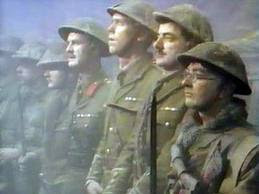
Photo: the cast of Blackadder Goes Forth getting ready to go over the top
Today was a day for sorting through paper, throwing stuff away until my brain got too numb to go on, trying to get ready to do income taxes.
I had “Blackadder Goes Forth” running on Netflix on my computer, as company while I worked. This series is set in the trenches of World War I, and I've seen parts of it before. It first ran on the BBC in the United Kingdom in the autumn of 1989, and unlike the three previous Blackadder series it had an antiwar stance. In the last episode, all the fooling around and smart ass remarks are done and the characters go over the top into No Man's Land. And that's how the show and the series ended.
Blackadder's last line, after Baldrick says he has a cunning plan to escape, is: "Well, I am afraid it will have to wait. Whatever it was, I am sure it was better than my plan to get out of this by pretending to be mad. I mean, who would have noticed another madman around here? Good luck, everyone."
World War I, or The Great War, as it was then, the "war to end all wars," truly was devastating to Britain, and the Blackadder series honored that at the end. I was seeing it twenty-one years after it first aired. This ending is famous, at least among some people, but I had never seen it before and it touched me deeply - and left me feeling deeply sad.
And I still feel that way.
Sunday, January 16, 2011
Drying the Dog

Photo by Laurie Shepherd Heath, photographer extraordinaire
Every time Jive the dog comes in these days he's sopping wet. He smells great, too. Well, he puts off a great smell.
There is a pile of old towels by the door, and a folding chair for me to sit in, and we have a few minutes of communion. I throw a towel over him from head to tail, and then commence rubbing him down and drying him off, and telling him what a good boy he is. This praise is most important when I get to his feet.
There may be dogs who like to have their feet messed with, but Jive is not one of those dogs. It is the foot drying that makes him start to walk away. He especially dislikes it when I run the towel between his toes, and try to get the mud loose from his claws. So I've learned to say, "Good boy, good boy," to him while I perform this delicate maneuver. That seems to calm him and get us through the tedious business.
Then when I'm done and he's only slightly damp and his paws don't leave little mud prints on the floor I sit back, and he stands there looking at me expectantly. Usually I'll throw another towel over his head and rub down his head and back again. We both enjoy that part.
Finally I say, "That's it," and we are done. He looks at me to make sure I really mean it, and walks off to whatever corner of the couch he has in mind.
When my husband dries Jive, he usually reminisces fondly about Sadie, our Doberman mix, who passed on a few years ago. When he was drying Sadie off, he would say, "Footy," and she would obligingly raise a paw for him to dry. She didn't like it, but she understood the necessity. Dobermans have reasoning powers.
Jive is a Lab mix, and is not burdened with reasoning powers.
While animals have always been a part of our family, we are not of the persuasion that animals are our babies or children. We had babies and children; animals are animals, with definite animal personalities and natures, and we love and respect them as such. Rick says now that after Jive goes, he would like to have no more dogs, or cats, or rabbits, or rats, or mice, or guinea pigs, or gold fish, all of which have lived with us over the years.
I understand his reasoning: you get so attached to them (except for some of those awful killer rabbits), and then they die. That's the main reason. Rick is tired of having his heart broken. Also there is maintenance and money. We're at an age and stage of life when we need to take care of ourselves, and animal companions take time and care. You have to train a dog, you have to clean the cat's litter box, and you have to pay for food and vet bills. Dogs chew things up, and dig up the yard, and run off and roll in disgusting rotten things and come home grinning. Cats leave disgusting things in the middle of your bed. Worst of all, you will probably have to make the decision to have an animal put down at the end of its life.
Sometimes as I'm toweling Jive down I'm thinking, he may be the last dog. It makes me a little sad, and it even makes getting the mud off his feet a sweet chore. It's a sad part of growing older, realizing that you are doing things for the last time, and that parts of your life are gone forever.
Then I think, I'll bet if I brought home a cat or a dog, Rick would fall in love with it and they'd hang out together. Maybe if as I presented it I said, "Good husband, good husband?" That might calm him down.
Don't tell him I'm thinking this, though. I want it to be a surprise.
Subscribe to:
Posts (Atom)

